Wolfgang Amadeus Mozart, Capella Istropolitana, Richard Edlinger - Salzburg Symphonies
1581 downloads at 34 mb/s
MP3 version
1766 downloads at 32 mb/s
FLAC version
ZIP Size MP3: 1581 mb
ZIP Size FLAC: 1766 mb
ZIP Size FLAC: 1766 mb
Tracklist
| 1 | Divertimento In D Major, K. 136 Allegro | 4:03 |
| 2 | Divertimento In D Major, K. 136 Andante | 5:06 |
| 3 | Divertimento In D Major, K. 136 Presto | 2:51 |
| 4 | Divertimento In B Flat Major, K. 137 Andante | 5:35 |
| 5 | Divertimento In B Flat Major, K. 137 Allegro di Molto | 2:42 |
| 6 | Divertimento In B Flat Major, K. 137 Allegro Assai | 2:14 |
| 7 | Divertimento In F Major, K. 138 Allegro | 3:51 |
| 8 | Divertimento In F Major, K. 138 Andante | 3:56 |
| 9 | Divertimento In F Major, K. 138 Presto | 2:09 |
| 10 | Divertimento In D Major, K. 205 Largo - Allegro | 5:03 |
| 11 | Divertimento In D Major, K. 205 Menuetto | 2:51 |
| 12 | Divertimento In D Major, K. 205 Adagio | 4:06 |
| 13 | Divertimento In D Major, K. 205 Menuetto | 3:14 |
| 14 | Divertimento In D Major, K. 205 Finale: Presto | 3:44 |
Notes
In 1772 Mozart was again at home in Salzburg. His first journeys abroad, at the age of six, had brought him great fame as an infant prodigy, and with his sister he had performed w hat seemed miracles of technique and musicianship for one so young. An extended tour took the Mozart family away from Salzburg for three and a half years, during which time they attracted the curiosity of audiences in Paris, London, Holland and throughout Germany. Late in 1769 Mozart left Salzburg with his father for his first visit to Italy and there he enjoyed similar success, now being able to fulfil a commission for an opera, Mitridate, re di Ponto, which was performed in Milan on Boxing Day, 1770. After five months In Salzburg, Mozart returned once again to Italy, where his Serenata, Ascanio in Alba, was to be performed for the wedding of the Austrian Archduke Ferdinand and Maria Beatrice d’Este, a princess of Modena.Mozart and his father returned to Salzburg once more in the middle of December, 1771. Next year, before they set out again for Italy, the English musician Dr. Burney was reporting that Wolfgang Amadeus was one more example of “early fruit being more extraordinary than excellent”. There were others ready to agree that Mozart’s early virtuosity had led to nothing, and in practical terms they may have been right. In late December the Mozart’s patron, the Archbishop of Salzburg, Count von Schrattenbach, had died, to be succeeded by Count Hieronymus von Colloredo, a zealous but unsympathetic ruler, who was to employ Molart for ten more years at his court, until a quarrel led to his dismissal in 1781.
The last decade of Mozart’s life was spent in precarious independence in Vienna, with early success, but no secure position and no adequate patronage. As a boy he had been famous. As a young man, however successful he might appear on brief journeys abroad, at home in provincial Salzburg he had felt slighted and undervalued, while the establishment in Vienna seemed to have nothing to offer that might match the ambitions that he and his father had nurtured.
The three so-called Divertimenti, K. 136, K. 137 and K. 138, sometimes known with rather more accuracy as the Salzburg Symphonies, have about them more of the latter than the former. A Divertimento was generally in a series of five movements and these three-movement works conform to the model of the Italian form of symphony. Since they were written in Salzburg early in 1772, they may well have been intended to serve a symphonic purpose during the coming journey to Italy, when wind parts could have been added, as required. They precede, in any case, a series of string quartets written in Italy later in the same year, and may themselves be played as quartets, although once again their three movements suggest another aim.
The first of the set, in D major, is a model of classical clarity, its first movement, in the usual tripartite sonata form, followed by a moving Andante. The final movement finds a place for counterpoint in its central development, adding a further dimension to music of concertante brilliance.
The second work, K. 137, in B flat major, opens with a gentler movement, in the expected form, and this is followed by a rapid Allegro di molto and a final Allegro assai of extreme clarity.
The last of the group, K. 138, in F major, with a classical first movement and a C major slow movement in similar form, closes with a brilliant rondo of transparent texture, an example of a perfection of art in which technical mastery is masked by simplicity of genius.
The Divertimento in D major, K. 205, is true to its name. It was completed in Salzburg probably in July, 1773, before a journey to Vienna, and probably intended as a tribute to Maria Anna Elisabeth von Antretter, wife of the Salzburg Court War Counsellor, for whose son Mozart was to write a celebratory Serenade later in the year, to mark the completion of his university studies.
Scored for two horns, a single violin line, viola, with bassoon, cello and double bass, the Divertimento opens with a slow introduction, leading to an Allegro that varies briefly in mood. The first Minuet has a contrasting G major Trio for the strings alone, and is followed by a slow movement in which the viola is given a fairer share of melody than is often the case. The Trio of the second Minuet allows the French horns some initial prominence, and this leads to a final movement full of witty allusion and variety well suited to the occasion for which it was presumably designed.
Capella Istropolitana
The Capella Istropolitana was founded in 1983 by members of the Slovak Philharmonic Orchestra, at first as a chamber orchestra and then as an orchestra large enough to tackle the standard classical repertoire. Based in Bratislava, its name drawn from the ancient name still preserved in the Academia Istropolitana, the historic university established in the Slovak and one-time Hungarian capital by Matthias Corvinus, the orchestra works principally in the recording studio. Other recordings by the orchestra in the Naxos series include The Best of Baroque Music, Bach’s Brandenburg Concertos and Mozart’s Eine kleine Nachtmusik.
Richard Edlinger
The Austrian conductor Richard Edlinger was born in Bregenz in 1958 and directed his first concert at the age of seventeen. In 1982 he completed his studies in conducting and composition at the Vienna Academy, having by then already acquired considerable professional experience on the podium. He was the youngest finalist in the 1983 Guido Cantelli Conductors’ Competition at La Scala, Milan, and since 1986 he has been Artistic Director of the Capella Istropolitana, an orchestra with which he has undertaken various European tours. Richard Edlinger has made recent appearances with the Vienna Chamber Orchestra, the Zagreb Philharmonic, the George Enescu Philharmonic, the orchestra of La Scala, Milan, and the RTSI Orchestra in Lugano. In 1987 he was appointed Music Director of Kamptal Festival in Austria.
Barcode and Other Identifiers
- Barcode: 0730099510820
Other versions
| Category | Artist | Title (Format) | Label | Category | Country | Year |
|---|---|---|---|---|---|---|
| 8.550108 | Mozart*, Capella Istropolitana, Richard Edlinger | Mozart*, Capella Istropolitana, Richard Edlinger - Salzburg Symphonies / Divertimento K. 205 (CD) | Naxos | 8.550108 | UK | 1988 |
| 8.550108 | Wolfgang Amadeus Mozart, Capella Istropolitana, Richard Edlinger | Wolfgang Amadeus Mozart, Capella Istropolitana, Richard Edlinger - Salzburg Symphonies (CD, Album) | Naxos | 8.550108 | Germany | 1988 |
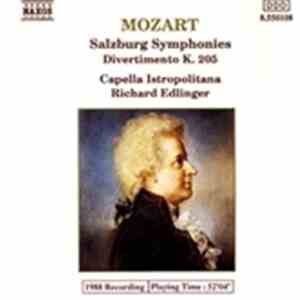
Singer: Wolfgang Amadeus Mozart
Album title: Salzburg Symphonies
Label: Naxos – 8.550108
Type: CD, Album
Country: Germany
Date of released: 1988
Category: Classical
Style: Classical
Rating: 3.9/5
Votes: 536
Format: MP3 RA VOC MP2 AHX WMA AC3 AUD FLAC
Album title: Salzburg Symphonies
Label: Naxos – 8.550108
Type: CD, Album
Country: Germany
Date of released: 1988
Category: Classical
Style: Classical
Rating: 3.9/5
Votes: 536
Format: MP3 RA VOC MP2 AHX WMA AC3 AUD FLAC
Related tracks or albums: