Octeto Buenos Aires - Tango Progresivo
1393 downloads at 34 mb/s
MP3 version
1620 downloads at 32 mb/s
FLAC version
ZIP Size MP3: 1393 mb
ZIP Size FLAC: 1620 mb
ZIP Size FLAC: 1620 mb
Tracklist
| 1 | Boedo |
| 2 | Mi Refugio |
| 3 | Taconeando |
| 4 | Lo Que Vendra |
| 5 | La Revancha |
| 6 | Tema Otoñal |
Notes
The 'New' Piazzolla and the Octet (1956-1959)This is the first of two records Piazzolla made with the "Octeto Buenos Aires", a 10" EP that unlike the second (that has been extensively reissued) has never been reissued in CD, yet it marks the beginning of Piazzolla's journey to transform Tango into "Modern Tango".
Piazzolla returns to Argentina after his studies with Nadia Boulanger, he decides to form the OCTETO BUENOS AIRES. With this group Piazzolla produces innovations that influence forever his attitude as player and composer. A new violent passion to arrange and to compose (in two years he composed and arranged more that 40 works); his decision for producing a rupture with the traditional tango, and the conviction for developing a group of musicians that come up to the same temperature musically and on stage as what he saw in Paris with the Mulligan Octet, which impressed him so much. The Octeto Buenos Aires definitively links him to the instrumental tango but not exclusively. With a formation of two bandoneones, two violins, piano, cello, electrical guitar and bass, this group becomes a proclamation of the rejection to the place of privilege that the singer had, imposed in the tango of the 40’s, and also and expulsion of the dancer (unavoidable protagonist of that tango and personage always present in the actual tango-spectacle). With the Octet, Piazzolla goes deep into chamber music criteria that show the independence of the tango with the pattern of the Orquesta Típica. Furthermore, the electrical guitar incorporates a new timbre not existing in the genre. But, since that time it is decisive in the inexorable fusion between the performance and the composition. The intensity that Piazzolla wants for his performance enters the score and intends to reach a physical palpitation. The bandoneón, his style as a player, his conception of the phrases, the unexpected treatment of the tempo, the visceral explosion that breaks the calm, is more that the excellence of the player: it affects the treatment of the score. Piazzolla considers the Octet is the start of the Contemporaneous Tango. But, the revolution that Piazzolla makes (farther on the influences that produces and a lot of subsequent imitations), is a solitary revolution. The genre can’t absorb it and doesn’t evolve: rather Piazzolla breaks the genre. "
Piazzolla (Astor) - bandoneon
Federico (Leopoldo) - bandoneon
Francini (Enrique Mario) - violin
Baralis (Hugo) - violin
Bragato (Jose) - cello
Malvicino (Horacio) - guitar
Stampone (Atilio) - piano
Vasallo (Jose) - bass
http://www.piazzolla.org/works2/tangoprogresivo.html
Other versions
| Category | Artist | Title (Format) | Label | Category | Country | Year |
|---|---|---|---|---|---|---|
| none | Astor Piazzolla, Octeto Buenos Aires | Astor Piazzolla, Octeto Buenos Aires - Tango Progresivo (CDr, Album, RE) | Not on Label | none | US | 1999 |
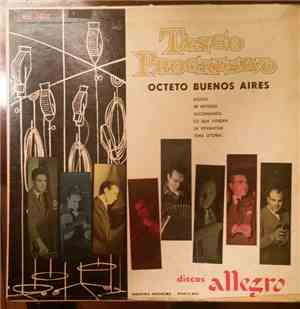
Singer: Octeto Buenos Aires
Album title: Tango Progresivo
Label: Allegro – AL 6001
Type: Vinyl, 10", 33 ⅓ RPM, Album, Ambisonic
Country: Argentina
Date of released: 1956
Category: Latin, Folk, World, & Country
Style: Tango
Rating: 4.2/5
Votes: 415
Format: MP3 MMF DMF TTA ADX VOX FLAC MP4 FLAC
Album title: Tango Progresivo
Label: Allegro – AL 6001
Type: Vinyl, 10", 33 ⅓ RPM, Album, Ambisonic
Country: Argentina
Date of released: 1956
Category: Latin, Folk, World, & Country
Style: Tango
Rating: 4.2/5
Votes: 415
Format: MP3 MMF DMF TTA ADX VOX FLAC MP4 FLAC
Related tracks or albums: